
Public data is increasingly recognized as a critical tool for strengthening transparency, accountability, and community well-being. When used effectively, it enables residents to understand how decisions are made, how resources are distributed, and how local governments respond to community needs. However, many communities still lack the tools, infrastructure, and enabling policy environments required to meaningfully engage with and benefit from data systems.
The Race, Prosperity, and Inclusion Initiative’s Equitable Community Data Pathways team explores how more equitable data ecosystems can be built through partnerships between communities, researchers, and government institutions. Their work highlights that improving well-being is not only a matter of generating more data, but of reshaping how data is governed, interpreted, and used in decision-making processes.
Understanding Community Well-Being in a Data Context
Within this framework, community well-being is defined as a condition in which a community is resilient, thriving, and self-governing. It extends beyond basic service provision to include the capacity of residents to assess challenges, solve collective problems, and actively shape their local environments.
Well-being also includes subjective and relational dimensions: a sense of safety, belonging, mutual support, and shared responsibility. Healthy communities are not passive recipients of policy decisions; they actively engage in collective action to influence decision-makers and shape municipal priorities that affect health, equity, and social outcomes.
However, many communities operate in contexts shaped by historical harm. Longstanding mistrust toward research institutions has emerged from unethical social science and medical practices, as well as from opaque decision-making systems that excluded community voice. These legacies continue to affect how communities engage with data initiatives today.

Key Questions Guiding Data Equity Work
The Equitable Community Data Pathways initiative focuses on three guiding questions:
- How can community well-being be enhanced through data collected in partnership with communities?
- How can data be made more accessible, understandable, and relevant to communities?
- What policy environments are required to sustain data equity and responsible data governance?
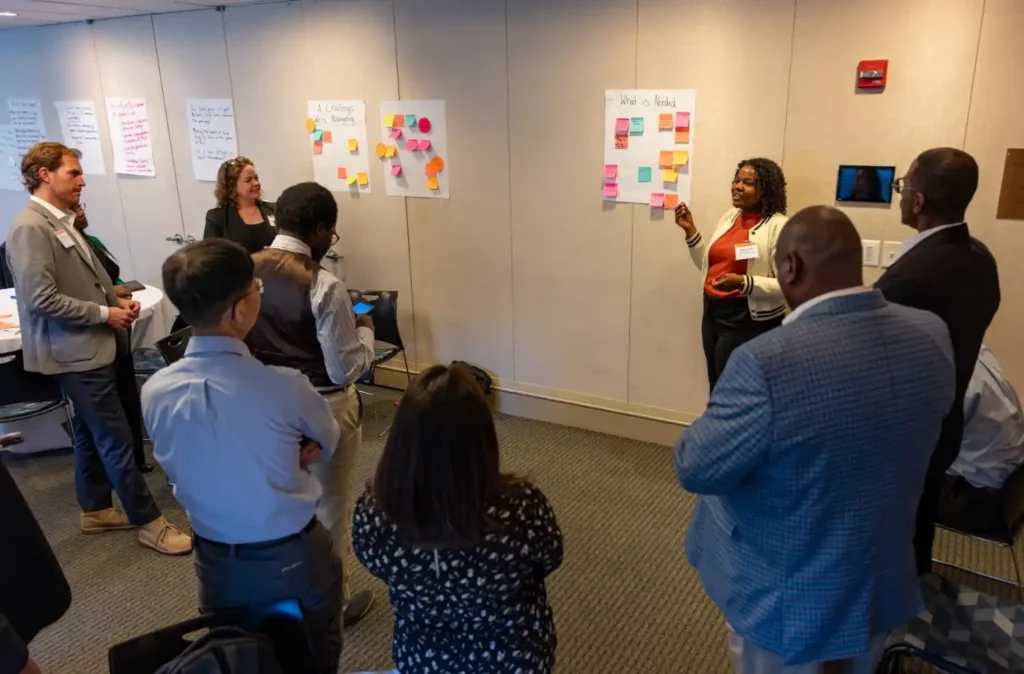
To explore these questions, the team convened discussions with community stakeholders, data practitioners, government representatives, and national organizations across multiple roundtables. These conversations were designed to identify practical strategies, governance models, and engagement tools that support community-centered, evidence-informed policymaking.
A key outcome of this work was an October 2025 convening that brought together communities and funders to deepen dialogue around data governance and shared responsibility. While the research is ongoing, a central insight emerged: sustainable data systems must be anchored in community well-being as their primary outcome.
From Data Collection to Data Governance
Early phases of the project revealed both opportunities and gaps in current data systems. While much attention has been placed on data generation and analysis, less focus has been given to how government-collected data is accessed, interpreted, and used by communities.
This led the initiative to refine its focus toward midsize municipalities, where governance structures are often more flexible but still face limitations in capacity, coordination, and transparency. The goal is to better understand how data flows through local systems and how it can be leveraged more effectively for policymaking that reflects community priorities.
Building Data Equity Through Literacy and Rights
One of the key strategies identified for democratizing data pathways is strengthening data literacy and data rights among community members. Data equity approaches emphasize that access alone is insufficient; communities must also have the skills, tools, and authority to interpret and use data meaningfully.
Equity-focused data systems aim to ensure that:
- Communities are empowered to understand how data is collected and used
- Decision-making processes are transparent and accessible
- Residents can participate in shaping data priorities and interpretations
This shifts data from being a purely technical asset to becoming a shared civic resource.
Why Traditional Data Systems Often Fail Communities
Despite the growth of community-focused data initiatives, many efforts fall short of their intended impact. A recurring challenge is the gap between technical data production and real-world usability.
Participants in the initiative’s discussions consistently pointed to barriers such as:
- Dense technical reports that are inaccessible to non-specialists
- Dashboards that prioritize visualization over understanding
- Lack of clear communication about how data informs decisions
In contrast, human-centered approaches—using plain language, storytelling, and clear decision pathways—were identified as far more effective in building trust and enabling engagement.

Trust, Transparency, and Communication
A central finding across stakeholder discussions is that trust cannot be built through data alone. While transparency is essential, it must be accompanied by consistent communication, accountability, and sustained engagement.
Transparency is not simply the publication of datasets; it includes explaining constraints, acknowledging tradeoffs, and communicating mistakes openly. In environments where institutional trust is low, these practices are critical for rebuilding legitimacy.
At the same time, trust depends on relationships, not just information. Data becomes meaningful when it is embedded in ongoing dialogue between governments and communities.
Data as a Common Language for Action
Participants emphasized that data functions most effectively when it serves as a shared language across communities, institutions, and policymakers. When interpreted collaboratively, data can bridge gaps in understanding and support coordinated action.
This includes creating feedback loops between residents and institutions, where data is not only collected but continuously discussed and refined. Tools such as dashboards and public data portals can support this process when designed with accessibility and clarity in mind.
However, the effectiveness of these systems depends on leadership, community engagement, and the presence of “data champions” who can translate information into action.
Linking Data to Community Action and Accountability
The initiative highlights how data can directly support accountability and community-driven change. For example, vulnerability indices and demographic data can help identify areas most in need of investment, such as infrastructure, public safety, or transportation.
Community engagement processes, including listening sessions, further enrich this data by capturing lived experience alongside quantitative indicators. This combination allows policymakers to better understand both needs and strengths within communities.
Importantly, data is also used as an organizing tool—helping communities advocate for policy changes, participate in civic processes, and build coalitions around shared concerns.
Toward Systems-Level Change
Beyond immediate policy applications, data can also help reveal structural patterns of inequality. By mapping interconnected systems such as housing, education, and environmental conditions, communities can identify how inequities are reproduced across sectors.
This systems-level perspective shifts attention from isolated problems to underlying causes, enabling more comprehensive and sustainable interventions. It also highlights the importance of addressing not only outcomes but the structures that generate inequity over time.
Conclusion: Toward Democratized Data Ecosystems
The central argument of this work is that improving community well-being requires more than better data—it requires transforming how data is governed, shared, and used.
Democratizing data pathways means:
- Centering communities in data governance
- Strengthening data literacy and access
- Building trust through transparency and communication
- Creating systems that reflect lived experience, not just institutional metrics
When communities are actively involved in shaping data ecosystems, data becomes more than an administrative tool. It becomes a mechanism for collective decision-making, accountability, and long-term social well-being.
Ultimately, equitable data systems are not only about improving information—they are about reshaping power, participation, and the future of community life.